

AI is going to reshape financial services more profoundly in the next twelve months than in the last decade. SME lending and payments - which have doggedly remained manual - are where that change will land first. Kriya and Allica Bank intend to lead it: bringing AI deeply into business banking, across every lending product we offer.
In the last three months, teams across Kriya have started using AI to take the time out of work that doesn't need a human: qualifying inbound leads and generating indicative quotes within five minutes of a client call instead of several hours, running a system of agents that credit-assesses applicants and produces credit papers ready for sign-off (compressing six hours of work into roughly one), and automating verification steps that used to be done by hand. The pattern is the same across each: radical efficiency gains where the work is mechanical, more time for judgment where it matters.
This post explains how we're set up to make that possible, and where we're taking it next.
The shape of the opportunity
We think about automation in three categories, and the dividing lines matter:
- Production systems: business-critical infrastructure that needs security, resilience, uptime, auditability, and full engineering ownership. Our lending decisions, customer accounts, and payments rails sit here.
- Workflow automations: lighter low-code or no-code builds where speed matters more than scale, often connecting two or three systems.
- Self-serve tools: small, targeted tools that help individuals or teams automate repeatable internal tasks.
The biggest near-term opportunity sits in the third category. These tasks are usually too small to justify an engineering roadmap slot, but collectively they consume meaningful time across the business. AI lets people in commercial, credit, and operations teams build the tooling themselves, with engineering providing the rails rather than writing the code.
Two goals: Empower and Connect
Empower: help teams build their own tools, safely
The role of engineering is shifting. It's still about building critical systems, but it's increasingly about enabling other teams to build for themselves.
In practice this means engineering exposes secure back-end capabilities as reusable building blocks. Business users then assemble front ends and workflows on top, with AI assistance. The infrastructure is in trial today, with back ends including Companies House, Experian Commercial, HubSpot, Slack, and our internal LLM access — and more on the way.
The guardrails are real: secure system access, training, clear ownership rules. Anyone can build, but accountability for outputs sits with the person who built the tool.
Connect: one AI workspace for the organisation
AI is far more useful when it can see organisational context. Our second investment is a single internal AI workspace, so people can find information and trigger actions from one place rather than jumping between tools.
It already supports chat, voice, dictation, files, screenshots, chat history, and live access to HubSpot. The roadmap adds deeper integration with our internal knowledge bases and operational systems, so the same workspace can answer "what's the status of this account?", "draft a follow-up", or "pull the latest credit file" without anyone leaving the conversation.
What this looks like in practice
Two threads are running in parallel — internal productivity, and customer-facing automation.
Internal productivity examples:
- A payment reconciliation tool that flags mismatches in remittance allocations, catching errors faster and more accurately than manual review.
- An invoice finance qualification and pricing tool that takes the front-end work from around an hour to roughly ten minutes, with better consistency and a cleaner audit trail.
- A credit memo automation workflow that takes a company number plus uploaded financials and assembles a draft underwriting paper. It runs as a multi-step agentic workflow: pulling company information, building a related-parties graph, fetching the credit bureau report, extracting multi-period P&L and balance sheet data from PDFs and spreadsheets, and running a web-sourced company overview and adverse media check — in parallel. Every extracted number carries provenance back to the source document and page, so underwriters can trace any figure to its origin. The goal is to cut new merchant underwriting time materially and give underwriters more time on the deals that actually need their judgment.
Customer-facing automation examples:
- AI-powered initial customer contact that generates indicative quotes and collects supporting documents, compressing days of back-and-forth into minutes.
- Automated invoice verification that uses LLMs not just to extract data from invoices, but to confirm the underlying transaction is genuine and to obtain automatic sign-offs from third parties on key delivery confirmations. Verification steps that used to take hours of manual chasing now happen in the background — which means customers get funded faster.
- A Companies House MCP connector plugged into the internal AI workspace, so sales people can pull a prospect's company profile, directors, PSCs, charges, and filing history mid-conversation — without leaving the chat or logging into another portal. The same connector pattern is how we'll wire in more data sources over time.
- AI-assisted lead handling and scoring designed to qualify and prioritise inbound interest before it reaches commercial teams, so human attention goes where conversion is most likely. The early versions are running now; the ambition is to automate a much larger share of the front of the funnel over time.
- CRM reactivation campaigns that keep Kriya–Allica front of mind with the tens of thousands of businesses already in our database.
The pattern across both threads: AI handles the volume and the extraction; humans handle the judgment. Underwriters spend their hours on the deals that genuinely need their experience, not on copy-pasting from PDFs. Sales spends time on the prospects most likely to close. That's the leverage.
How we intend to operate
A few rules we apply consistently:
- Use AI where it helps. If it improves productivity or reduces effort, use it. We'd rather people experiment and learn than wait for permission.
- Accountability stays with the user. AI is a tool, not a decision-maker. The person producing the output owns it.
- Verify before you trust. Models still get things wrong. Important outputs get reviewed — and the systems we build make verification easy, like the provenance trail in the credit memo workflow.
- If you build it, you own it. Tool creators are responsible for maintaining and improving what they ship — and for contextualising any new processes with the teams that touch them, including updating documentation when steps change, are added, or are removed.
- Protect confidentiality. Confidential or customer information doesn't go into general-purpose LLMs.
- Be mindful of cost. AI usage isn't free. Expensive workflows need a reason.
These are unglamorous but they're what makes the rest sustainable. The teams shipping the most interesting work are the ones that take these seriously.
Why this matters more inside Allica
Kriya was acquired by Allica Bank in October 2025. The combination puts bank-grade funding behind a digital-native credit business — and an AI-fluent operating model behind a bank that intends to grow faster than its incumbent competitors.
For SMEs that translates into faster decisions, cheaper funding, and a better experience across the lending journey. For us, it means the AI work above isn't a productivity story — it's part of how the combined business intends to scale relationship-led SME lending without losing the speed Kriya is known for. Few banks have an opportunity to rebuild SME lending workflows from the ground up with AI in the loop from day one. We do.
We're still early. The infrastructure, guardrails, and culture all need to keep evolving. We're hiring across engineering, product, credit, and commercial roles to take this further — if any of this sounds like the problem you want to spend the next few years on, we'd like to hear from you.

Power your growth with Kriya
Explore related posts
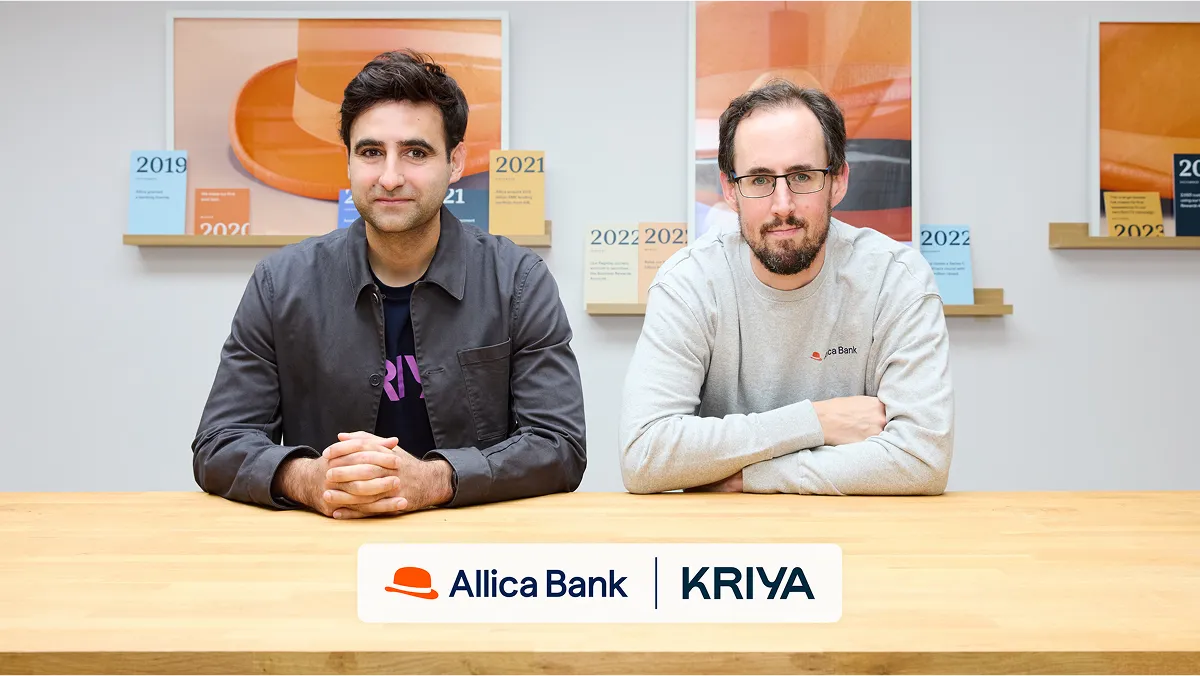
Allica Bank acquires fintech Kriya in a move to deliver £1 billion of SME working capital finance by 2028
Allica Bank announces the acquisition of Kriya, the award-winning SME lending fintech specialising in SME working capital and embedded finance.

Allica Bank: The Business Bank Behind Kriya’s New Chapter
Kriya will continue doing what it does best: building digital credit products with excellent customer service — now backed by the scale and infrastructure of a leading business bank.
Why a bank partnership changes everything: scale, pricing, and experience – all in one
We’re combining bank-grade funding capacity with fintech-grade experience, unlocking a new level of flexibility, scalability and innovation for growing businesses.